
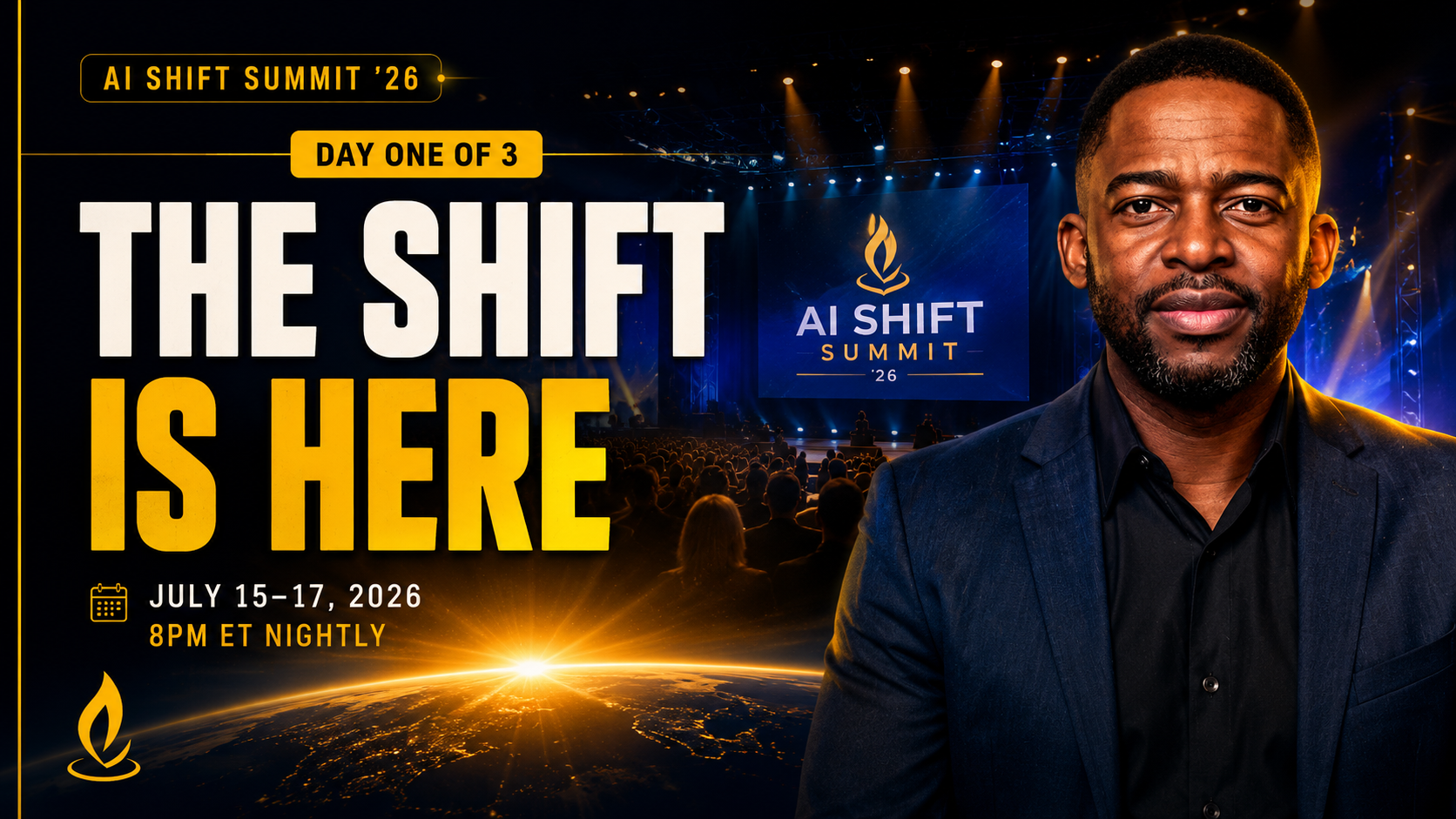
The AI Shift Already Started: How Faith-Based Coaches Can Build a Coaching Business Before They Fall Behind
The AI shift in coaching is not coming — it already started. The US life coaching market sits at $2.6 billion and grows at 9.5% every year, while the broader personal development market is projected to climb from $48 billion in 2024 to $67 billion by 2030. Yet a disproportionately small slice of the coaches capturing that growth are faith-based, largely because many in faith communities believe using AI means trying to replace God. That hesitation is costing them visibility, clients, and income. This teaching breaks down what the shift actually means, why faith-based coaches are uniquely positioned to benefit, and the three core leaks that keep most coaches invisible — no matter how gifted they are.
Why Is the AI Shift Such a Big Deal for Coaches Right Now?
AI collapses the cost of content creation, outreach, and delivery to almost zero. Tasks that once consumed entire workdays — writing sales copy, drafting follow-up emails, scheduling appointments, doing market research — can now be completed in seconds or handled automatically by AI agents running in the background. In 2023, roughly 35% of marketers were already using AI tools. By 2024 that number had jumped to 74%, and it continues to climb. Coaches who ignore this shift do not stay neutral — they become invisible. The coaches capturing market share are not necessarily the most gifted or the most experienced; they are the ones who identified their audience's number-one pain point and built a system to solve it faster than anyone else.
Is AI Compatible With Faith-Based Coaching?
One of the most persistent obstacles holding faith-based coaches back is the belief that adopting AI is somehow spiritually compromising — that using it means trying to replace God. This idea is described plainly as ignorance. There is no such thing as a Christian marketing system in the sense that the tools themselves carry a denomination; the tools work, and what matters is how you use them. A faith-based platform can be built on biblical principles while offering tools that any coach — regardless of background — can use effectively. The standard and the message can come from Scripture; the infrastructure is simply the vehicle that carries that message to the people who need it. A calling without a vehicle becomes a burden, because you have no reliable way to reach the people waiting to hear from you.
What Can AI Actually Do for a Coaching Business?
AI does not replace coaches — it replaces the tasks that drain coaches of the time they should be spending with clients. Specifically, AI can handle scheduling, custom email systems, content drafting, appointment booking, phone calls to prospective clients, follow-up sequences, lead research, and virtually all administrative work. Consider that seven to eight percent of a typical coach's time is consumed by admin tasks — paperwork and logistics that have nothing to do with actual coaching. AI agents can be set to email a new client on a defined cadence, generate a response draft when the client replies, and flag it for approval or send it automatically. An AI agent can scan a city or keyword set and begin making outreach calls without the coach lifting a finger. What this buys back is time: three hours saved per piece of content, two and a half hours saved every workday — time that can be reinvested into building relationships, which is the irreplaceable core of coaching.
What Coaching Skills Can AI Never Replace?
While AI handles logistics and content at scale, the human elements of coaching cannot be automated. Clients do not buy an offer first — they buy into the coach first. They invest because they feel a personal connection, because they sense genuine empathy, and because they trust the coach's discernment and accountability. Those qualities — wisdom in dealing with people, spiritual or personal discernment, and the actual relational work of coaching — are what AI frees you up to deliver more of, not less. The goal is for AI to run the administrative layer so that the coach can be fully present in conversations, fully focused on the transformation the client is paying for.
Can You Really Build Coaching Offers Without a Website or Sales Funnel?
Yes, and this is one of the most practical shifts the AI era makes possible. A coach with a smartphone and an internet connection can type a brief description of the offer they want to create, click a button, and have AI build that offer — no website required, no extensive sales funnel, no coding knowledge needed. The AI builds the framework; the coach reviews and edits the parts they want to adjust. When a prospective client claims the offer, the system logs the signup, sends confirmation emails, and records all the details automatically. Payment processing, scheduling, and follow-up are all handled inside the same system. This removes the seven-plus-platform juggling act that overwhelms so many coaches who currently have to use separate tools for video, email, recordings, and offer delivery.
What Are the Three Leaks Draining Most Coaching Businesses?
Every coaching business that is stalling — regardless of how talented the coach is — tends to leak in exactly three places: the offer, the audience, and the system. All three work together, and weakness in any one damages the other two.
Leak One: People Like You, But Nothing Is Clear to Buy
A great personality and genuine credibility are not enough if the offer itself is confusing. Many coaches bundle five or six different outcomes into one offer, which triggers decision paralysis — the same feeling you get when a restaurant menu has sixty items and you cannot choose anything. An effective offer solves one clear pain point and communicates exactly what transformation the client will experience over a defined period. The offer must answer: what will change for me if I say yes to this?
Leak Two: A Great Offer That Nobody Hears
Empty rooms are the sign of a system problem, not a content problem. If no one is seeing or hearing the offer, the issue is that there is no reliable mechanism for consistently reaching the right audience. Posting on social media without a strategy is not a system — it is a way to burn out. A system means there is a structured, repeatable process for finding people who have the pain point the coach solves, getting the offer in front of them, and following up automatically.
Leak Three: Clients Exist, But the Coach Is Drowning in Admin
This is where coaches who have already built an audience often stall. They spend so much time on website questions, payment setup, tech support, and email management that they have no capacity left for the clients themselves. AI eliminates this leak by automating the administrative layer entirely, so the coach can focus on the work the client actually came for.
How Do You Start a Coaching Business With AI if You Have No Tech Background?
The barrier to entry is lower than it has ever been. You do not need to know how to code. You do not need a laptop. If you have a smartphone and an internet connection, you can create an account, build an offer by describing it in plain language, and go live — all from your phone. The framework has already been built; the AI builds the offer structure for you based on a few words of input. The math is straightforward: two clients paying a modest monthly rate can generate meaningful annual income. You do not need to have everything perfectly figured out before you start. The market is not waiting for perfection — it is waiting for coaches who show up with a clear message and a reliable system.
What Does It Mean to Master AI Instead of Fearing or Worshipping It?
There is a balance between two extremes that both cost coaches their voice. Ignoring AI entirely makes a coach invisible in a market where the majority of competitors are already using it. But over-relying on AI — treating it as the source of ideas and direction — strips away the authentic voice that makes a coach worth following. The right posture is to decide what direction you want to go, bring your own ideas and convictions to the table, and then use AI to sharpen, execute, and amplify those ideas at a speed and scale no individual could achieve alone. The future of coaching belongs not to the most gifted coach or the most credentialed one, but to the coach with the best systems — a clear offer, the right audience, and AI-powered infrastructure that lets them deliver transformation without burning out.
Take the next step in your Kingdom coaching journey
Get practical, faith-driven coaching insights delivered straight to your inbox. No spam, no fluff — just Kingdom strategy that works.